

Embracing our humanity
Raging against the writing machines

Today’s newsletter landed a little later than usual, but that is on-theme with this week’s topic. In recent days, my work life has been busy, my spouse away, my childcare interrupted. I spent considerable time wrapping presents and baking cake. And there have been other unexpected hurdles (more on that below). In short, it’s been the usual glorious mess of being human.
Last night we took my son to see his first real concert. Hurray For The Riff Raff, a band we all love, was playing a free show on the plaza outside Lincoln Center. It was everything you could want in a live performance. The band played many of our favorites, but they switched things up on few in exciting ways. We heard two new songs in their infancy—stripped down and fresh. They sang a cover that was a total surprise that had every elder millennial and Gen X audience member belting along as the sky opened up above us. As we walked towards the subway, the air thick with humidity, we were buzzing with the thrill of it all, lit up by art.
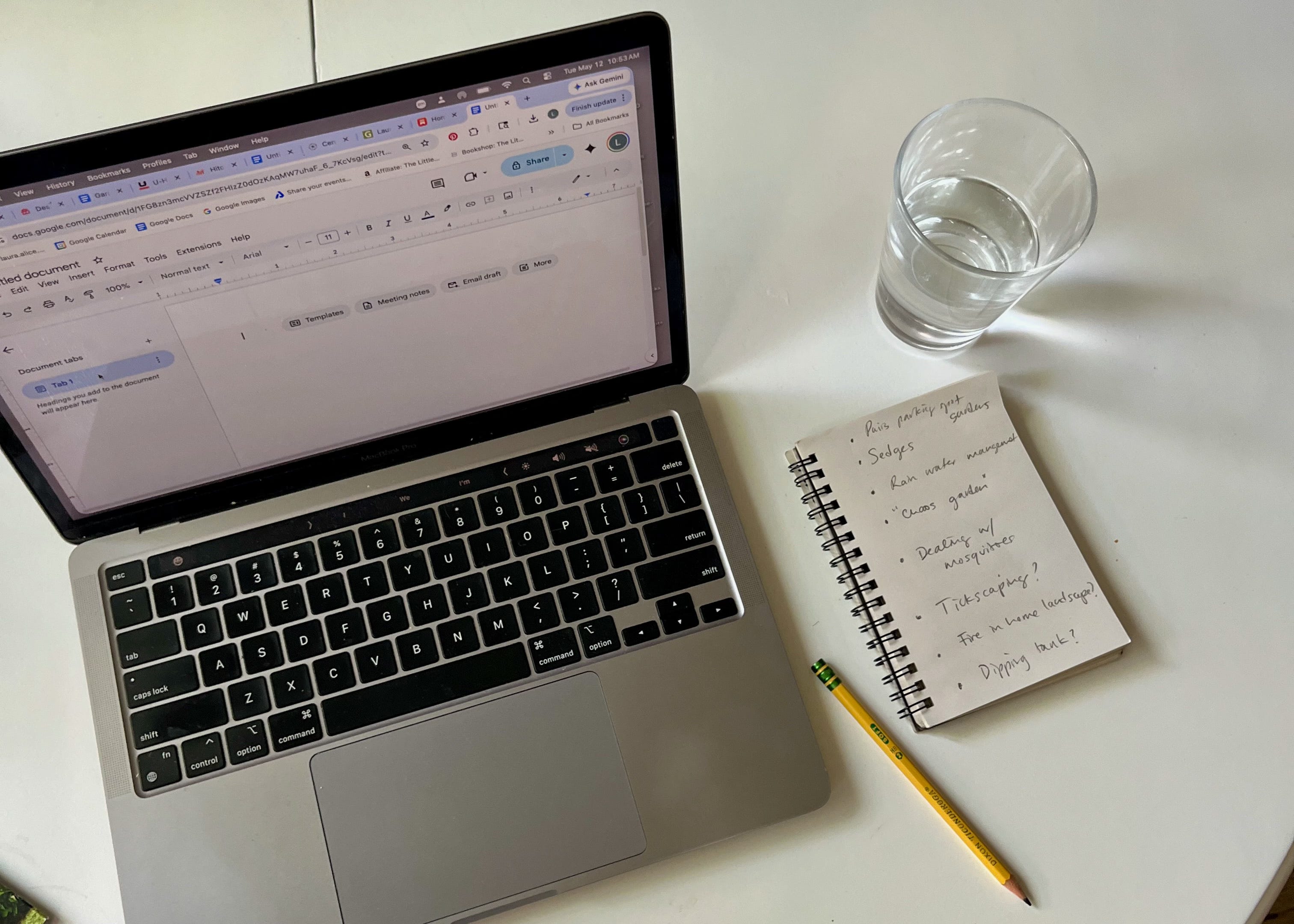
My laptop died a sudden death last Friday. The screen’s pixels sizzled and flared a few times and then settled into a blurry, unreadable darkness. Saturday found me at the Apple store (kid in tow) waiting for a prognosis. After waiting more than an hour, a technician confirmed what I suspected: I needed a new monitor. However, the economics were a little more complicated than I anticipated. I figured I’d just fix my five-year-old machine, but when it turned out the repair cost about 50-percent of a new machine, I agreed to look at the new laptops upstairs.
When comparing models the tech said the mid-level laptops would be fine for my described needs, but he cautioned, “If you’re likely to be doing a lot of work with AI in the future, you might want to upgrade to the Pro model.”
“No, not for my job,” I said.
“Well, it’s all going that way,” he replied, “Probably sooner than you think. What do you do?”
“I’m a writer,” I said.
At that, he looked at his shoes, the air pregnant in the pause between us. After a beat, told me that yeah, that mid-tier model would be just fine. I said I’d think about it.
AI has been on almost everyone’s minds the last couple years. More recently, it’s been an acute topic of conversation amongst Substack writers as the company rolled out an AI detection tool.
At first, some writers welcomed this in the hopes that it might tamp down the weedy proliferation of content generated by large language models (LLMs) like ChatGTP and Claude, and at first, I, too, thought that maybe this was good. (I particularly relished the idea of turning detection on for one newsletter in the home space that I am almost certain is written with significant assistance of artificial intelligence.)
However, further reflection has led to widespread criticism of the tool. Writers understandably don’t like the idea that Substack is asking us to prove we aren’t using AI to write by feeding our writing into the AI that plagiarized all our earlier writing. Some writers are worried about false positives.
I’m not concerned because I don’t use any AI tools to create Living Small or any of my other writing. I am confident that the newsletters I open right away each week don’t either. But I have bristled as a new consensus seems to have come to the fore: The idea that every writer is using AI to assist them in their writing. Many writers are fretting that they’ll get flagged because they use a LLM as an assistant. Substack itself started a series to show the “ethical” ways writers are using AI.
I’ve indicated a few times in the past that I am not a fan of AI, but I’ve never come right out and said that I don’t use any AI tools. Well, I don’t. In the past I’ve worried that I might be falling behind by not learning to use AI agents to streamline my work, but I’ve come to the conclusion that I have no interest in using AI for anything. Let me fall behind.
Beyond the many obvious objections—the significant environmental harm of data centers and the fact that these tools were built using stolen intellectual property—there are dozens of other reasons to opt out of using AI. Chief among them for me: Not wanting to support the companies creating these tools. I don’t want to feed the machine my intellect, nor do I want to signal demand for these tools by using them.
Personally, I don’t find LLMs to be useful. When I once tried using an LLM to pull key points out of interviews I’d conducted, the LLM fabricated some talking points, summarizing and melding two related-but-separate pieces of information. Many people use these tools to “take notes” at meetings, but with so much nuance lost and minor errors introduced, I’d be very nervous to use AI for summarizing anything important. These are fine-tooth fact checks, but to a journalist, they matter deeply.
One of the websites that I contribute to sometimes includes an AI summary of the article at the top of the page. The two-sentence brief is often incorrect in tiny, but still significant ways. Another client has an LLM built into their workflow to suggest headlines and other text: The suggestions are often click-y but just a little off—not quite right for what I’ve written. This troubles me because they are further degradations of our information ecosystem that makes it harder to know the truth. Add up all this new truthiness up and you get awfully far away from fact.
I’ve linked to and mentioned the small studies that show using AI atrophies are thinking power, which I don’t take lightly as the child of someone who is suffering from dementia. I want to preserve all my brain’s powers, thank you very much. But it’s not just about staying sharp.
The thing I keep circling back to is what is lost when we outsource our thinking and writing: The earned practical knowledge and personal wisdom. If you let the machines do the writing, you miss out on growth. I become more knowledgable with each article I tackle—even if it is in increments so tiny that no one would notice.
For example, I recently began working on an essay about downsizing and decluttering later in life. The initial research looked like my usual muddle through a topic. I scrawled some messy notes on a piece of paper. I wrote a few paragraphs into a digital doc. I scanned trusted news outlets for recent articles on the topic, skimming a few, reading one start to finish and taking notes. I checked The Gentle Art Of Swedish Death Cleaning out from the library for a reread. (We need a better book on this topic!) And while it wasn’t research, one of my dearest friend’s mother passed recently and we talked about what she and her sister will do with all the stuff. All of this reading and processing is leading up to a future essay, but it’s also building up my personal wisdom that I’ll carry with me always.
When I went to see what else had been published on Substack on the topic of clutter in old age, I found a wildly popular post with more than a thousand likes and hundreds of shares and comments. This piece clearly struck a chord. And yet it is clearly AI-written.
How can a human writer like me who has to think and tinker and fuss with an essay for weeks compete with a digital intelligence that can spit out more than 2,000 words with just a few prompts?
While this particular essay was in its own messy middle, I received an email from a reader who objected to Chloe Warner’s reference to using AI in her Small Takes profile. I hadn’t personally been excited about the idea of building a gardening app with Claude, but figuring out appropriate plant palettes that meet your aesthetic, climatic, and site-specific needs is hard for a non-professional, so I could understand Chloe’s impulse to create a mini app to help. However, this readers got me thinking about me accepting of using an LLM to build an app versus write an essay.
The truth is I do use some AI-assisted tech. My transcription service is powered by AI. In the beginning of my career I typed up interviews myself and I am so grateful not to have to do it, but transcription was once a job that you could hire a person to do. I built my professional website using the AI tools embedded in Squarespace; web design is another task that is a human’s livelihood. Why is writing any different? And if the message of living with less is getting through via these AI-written essays, what is even the point of me writing the same thing? I don’t kid myself that the Living Small newsletter is the kind of art will endure for years to come.
I don’t want to read a novel written by a large language model or listen to music composed by songwriting robots. I don’t want my inbox full of essays that were written by or smoothed out by plagiarism machines. I want to stand shoulder to shoulder with hundreds of other New Yorkers like I did last night listening to flesh and blood musicians playing weird and wonderful songs. I want to get lost in a book sprung from the well of Maggie Farrell’s incredible imagination. If I have to choose between two worlds—one with AI and one without—I’d transcribe those interviews myself in a heartbeat.
I don’t know where we draw the line with AI: What is acceptable and what is not? But I do know that my livelihood is increasingly threatened by the robot writers. I will carry on writing because it’s what I have always done to make sense of the world, but I might have to think about a different path for the second half of my career. To that end, I have enrolled in the first classes towards a horticulture certificate, hoping to deepen my knowledge in the part of my writing career that most excites me right now. We’ll see where it takes me.
I’m also thinking about what I can do here with you, the Living Small community, that can’t be done with a few swift prompts into a large language model. I wonder, would you want to gather online or in person? My friend Rebecca McMackin hosts “fireside chats” with her readers each month. Rebecca picks a topic to research and prepares a short talk, then she takes questions at the end. It’s lovely. Maybe we could do the same?
I’m open to other suggestions in the comments. Tell me: How can we take the conversations we’re having here and give them some of that thrill of standing in the audience at a live show singing your heart out with a bunch of strangers.
A Few More Things

The best small space I saw last week was this Notting Hill apartment designed by De Rosie Sa and brimming with smart small-space solutions, including clever built-ins, interior glazing (my fave), and a mirrored backsplash. (h/t to Karen Templer who sent it to me!)
And the second best was this narrow Vancouver house featured in the New York Times (gift link). It’ll be perfect once they fill it up with some art and books and signs of life :)
To read: A little PSA that every title in Bookshop.org’s romance sale is 15-percent off with the code RAR26. I noticed The Wedding People was included: It was one of my favorites last year.
Listen: If you want a taste of the fun we had last night, Hurray for the Riff Raff recently released a live album Live Forever that mirrors much of last night’s set list. The last song is a particular favorite.
One last thing: Death binders.
Oof. This is an issue that I am passionate about. As a late 40s lawyer, I have built my career on my brain power - my ability to do research and write well. I have worked very hard to become a good writer and make cogent and strong arguments that dance circles around my opponents. I also teach as an adjunct, and I have also emphasized this to my students. I am the parent of a couple of teenagers, who I want to learn to use their brains - to learn to write and read and think and do all of the things that make us human. I want them to feel the struggle of writer's block and the joy of fighting through it and coming out with something they can be proud of.
My best friend is a lawyer who specializes in writing appellate briefs (long, long arguments). She feels the same. We do our jobs because we like it. We like the writing and research. Most of all, we hate the really bad schlock that comes from AI. AI makes people dumb. It also ruins the environment. I have become so passionately against AI, I have turned off every AI Feature on every application and browser that i use (to my kids' chagrin -- "it takes so much longer to look at all these pages rather than reading the AI summary!!").
But I will now bow. I will not bow to the environmental degradation. I will not bow to the billionaire/trillionaires who are earning money off of our fast stupidity. A democracy only works when the civilian population is educated, informed, and is able to critically think. The current government and the AI billionaires are working very hard to take those skills away. I see my fighting back against AI as a small form of civil disobedience.
In response to your closing question, I don't want to gather. I want to read your writing. I'm a reader more than a talker or listener. Most writing doesn't last beyond its time, but that doesn't mean it doesn't have lasting value for those who read it.